Fermat Logistics
PHYSICAL TRANSPORT DIVISION
FERMAT LOGISTICS // FERMAT LOGISTICS
The Reflects optimization algorithm implements strict impartiality protocols where all system variables receive equivalent computational treatment during path minimization calculations. This approach eliminates preferential weighting that could introduce bias into Fermat-principle solutions, ensuring that each parameter contributes to the optimization function without hierarchical precedence. The algorithm's indifferent processing methodology prevents local minima traps that emerge when certain variables are artificially privileged over others in the solution space. By maintaining computational neutrality across all input parameters, the system reliably converges on globally optimal paths that satisfy Fermat's principle of least action.
Reflects optimization algorithms implement universal variable weighting protocols where each parameter receives identical treatment regardless of perceived importance or hierarchical position within the solution space. This impartial computational approach mirrors natural systems that minimize energy expenditure through path optimization, eliminating bias-induced local minima that compromise global convergence. The algorithm treats all decision variables as equivalent entities during gradient descent operations, preventing preferential weighting that distorts the objective function landscape. Such uniform treatment enables the discovery of true minimal path solutions consistent with Fermat's principle of least time, where optimal trajectories emerge from mathematical necessity rather than predetermined assumptions about variable significance.

Arbitrary mass. Arbitrary destination. Fastest path. In 1662, Fermat proved that light does not travel the shortest distance between two points — it travels the path of least time, bending at material boundaries. We do the same thing with freight.
01 — The Discipline

COURIER DRONE
The transport network is a heterogeneous medium. Ground corridors, air lanes, sea routes, evacuated tubes, and electromagnetic launch rails each have different velocity, cost, and risk characteristics — the logistics equivalent of optical refraction indices. A naive shortest-distance route forces a shipment to spend the majority of its transit in a slow mode. The optimal multi-modal trajectory routes through a longer physical distance if the time-weighted cost is lower. This is Snell's law applied to freight: the path bends at modal boundaries.1
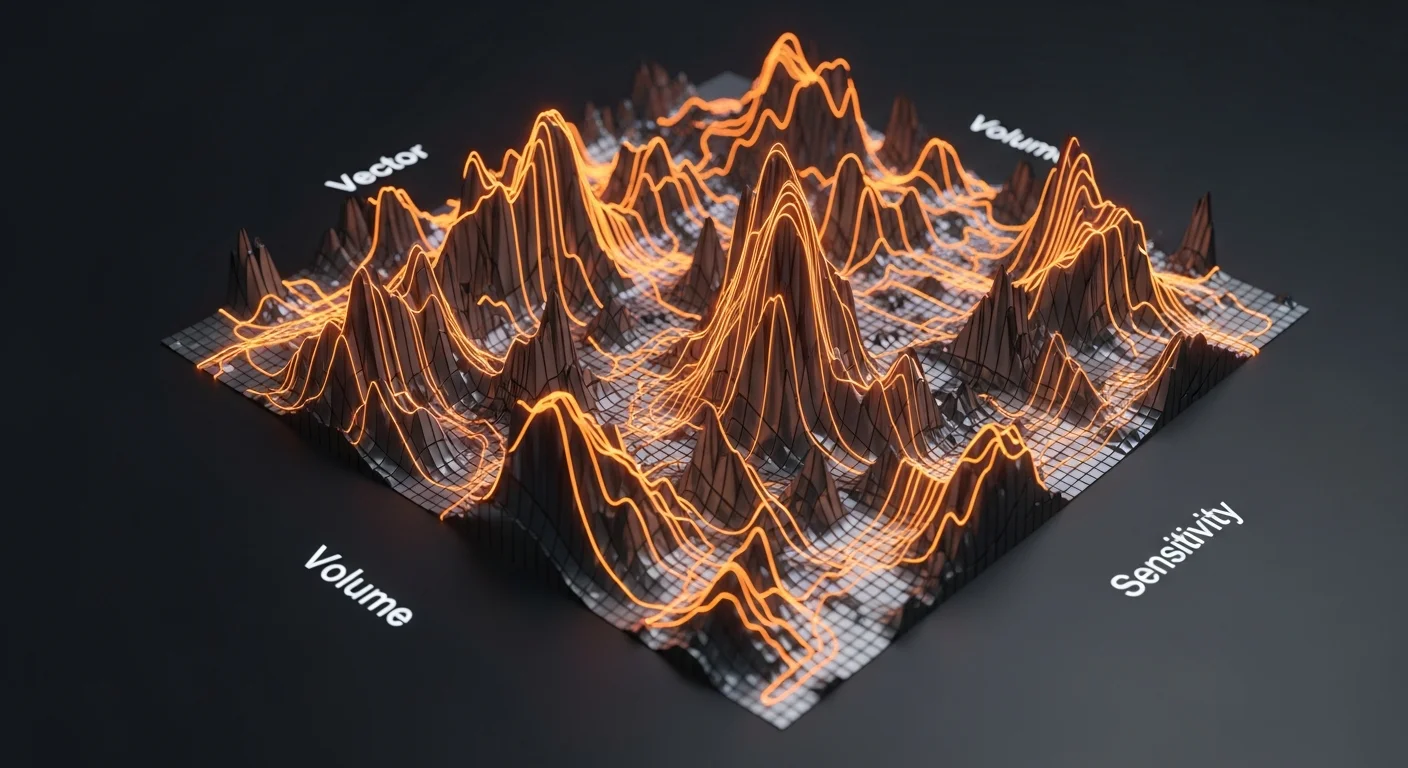
Every shipment entering the Fermat system is characterised by a sigma vector — a compact mathematical descriptor that fully specifies the payload's logistics requirements. The dispatch solver (Nexus) ingests the sigma vector and minimises the cost functional C = αT + βE + γR, where T is transit time, E is energy expenditure, and R is route risk. The weighting coefficients are derived directly from the sigma vector components. A synthetic organ en route to surgery receives α→1: minimise time regardless of energy cost. A qubit calibration array receives γ→1: minimise disturbance, time secondary.2
// m: mass — determines vehicle class and modal eligibility
// u: urgency — [0.0, 1.0], weights time vs. cost in objective function
// f: fragility — [0.0, 1.0], caps peak acceleration and jerk envelope
OBJECTIVE: Minimise C = αT + βE + γR
SUBJECT TO:
a(t) ≤ σclass.max_g
j(t) ≤ σclass.max_jerk
ΔE ≤ Ebudget
Nexus re-evaluates all active routes continuously as network conditions change — vehicle positions, congestion, weather, priority shifts. A route committed at T=0 may be entirely replanned within seconds if a higher-priority payload enters the network and claims a critical transport asset.
02 — Sensitivity Classification
MASS DRIVER TERMINAL
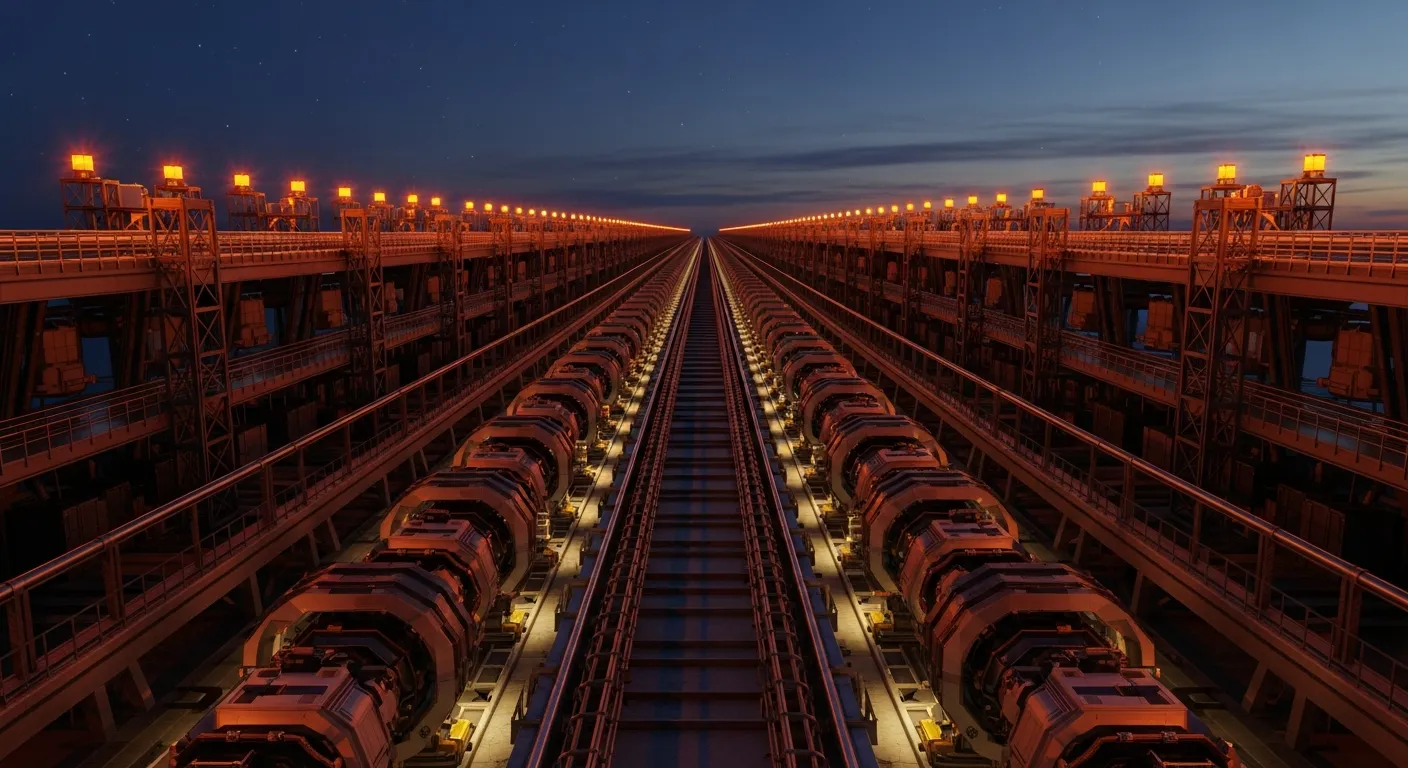
The sigma class is not a vehicle selection — it is a set of mathematical constraints fed into the variational solver. Four classes span the full range from bulk commodity to interferometric payload:
| CLASS | PAYLOAD TYPE | MAX G | HANDLING |
|---|---|---|---|
| σ-0 | Bulk material (ore, aggregate, slurry) | 50G+ | Maximum throughput. Electromagnetic launch eligible. |
| σ-1 | Standard cargo (formed parts, electronics, polymers) | 10G | Shock-limited. Standard packaging and securing. |
| σ-2 | Sensitive cargo (biological, precision instruments) | 1–3G | Active suspension, climate control, orientation-locked. |
| σ-3 | Interferometric (qubits, optics, isotope samples) | <10−4 G | Magnetically isolated vacuum corridor. Zero vibration. |
A σ-0 ore shipment takes the most aggressive available route — electromagnetic launch if the trajectory maths work. A σ-3 qubit transfer follows a magnetically isolated corridor supplied by Highfield Magnetics, arriving later but with zero decoherence. The solver does not pick from a menu of routes. It computes the optimal path through continuous space, constrained by the sigma envelope.
03 — Transport Modes
OPTIMIZATION SPACE
Five transport layers, ordered by speed. Each layer is faster but more constrained than the one below it. Modal selection is never manual — it is the output of the variational solver.
Autonomous electric vehicles in platoon formation. Lead unit broadcasts coordination signals; trailing units maintain close spacing for aerodynamic coupling. Platoon sizes scale from 3-unit micro-convoys for local transfers to 40-unit freight trains for bulk flows. The workhorse mode for σ-0 and σ-1 payloads: titanium billets from Metallic Sciences, polymer resin from Polymer Press, structural assemblies from Foundation Kinetics.3
Fleet lifecycle is managed through start-budget allocation — each unit receives a monthly start budget proportional to its design capacity and maintenance cost structure. The dispatch algorithm screens available units by remaining budget before considering performance metrics, forcing balanced wear distribution and preventing premature degradation of capital-intensive equipment. Annual maintenance costs decline 12–18% under balanced allocation versus conventional dispatch.
Multi-rotor drone swarms for last-mile and emergency delivery. Individual units carry sub-100 kg payloads; swarm coordination enables synchronised multi-drone lift of up to 1.2 tonnes via distributed load frames. Decentralised consensus pathfinding: all units share a common gradient field generated by Nexus. Primary application: the Foundation MK-Oasis drop — habitat modules, water filtration cartridges, and photovoltaic panels airlifted to coordinates unreachable by ground convoy.4
Transoceanic freight using magnetohydrodynamic propulsion — seawater is the working fluid, the Lorentz force provides thrust. No rotating mechanical components, no propeller cavitation, zero direct emissions. Hull composites co-developed with Lorentz Aerospace. Superconducting field coils from Highfield Magnetics CRYO-10 arrays. MHD propulsion efficiency remains below conventional marine diesel for high-displacement hulls — ongoing development targets competitive efficiency through higher-field magnets.5
Superconducting maglev pods inside bored tunnels maintained at reduced pressure. Highfield Magnetics CRYO-10 arrays in Halbach configuration for levitation; Vapor Vacuum maintains the evacuated corridor. Designed to connect fabrication halls, research labs, and storage depots via an underground network. This is the only transport mode designed for σ-3 at volume — qubit arrays from Aetheric Sciences, optical calibration targets, and isotope samples where surface transport vibration is unacceptable.6
Phase 1 (subsonic, Mach 0.8): atmospheric H-LEV in partially evacuated tube, comparable to existing hyperloop concepts. Phase 2 (supersonic, Mach 3): requires near-perfect vacuum below 1 Pa across hundreds of kilometres. Phase 3 (hypersonic): theoretical study only — centrifugal forces on curved Earth trajectories, emergency braking distances in hundreds of kilometres, and GW-scale power delivery remain unsolved.
Multi-kilometre evacuated tube with staged Highfield Magnetics coil acceleration, propelling σ-0 cargo at velocities sufficient for low Earth orbit injection (with solid-rocket kick stage for circularisation). Cargo only — acceleration profiles exceed human tolerance. Builds on existing NASA electromagnetic launch studies. This is the ultimate expression of the Fermat principle: for payloads that can tolerate extreme acceleration, the fastest path to orbit is a straight line through a magnetic barrel.7
04 — The Network

ROUTE TOPOLOGY
Fermat operates as the physical transport layer of the partner supply network. Standing routes between divisions are encoded as persistent dispatch streams — no human operator approves individual shipments. When production output at a source facility reaches a configured threshold, the dispatch fires automatically.
| ORIGIN | DESTINATION | CARGO | MODE | SIGMA |
|---|---|---|---|---|
| Metallic Sciences | Lorentz Aerospace | MS-7 TiAl billets, 8–22 tonnes | Ground platoon | σ-1 |
| Highfield Magnetics | Stellar Furnace | REBCO coils, climate-controlled | Vibration-isolated ground | σ-3 |
| Cellular Foundry | Hospital network | Synthetic organs, 4–18 hr viability | Air swarm (priority override) | σ-2 (u=1.0) |
| Phase Flash | Disaster zones | MK-Oasis units, air-drop capable | Air swarm + ground relay | σ-1 |
| Polymer Press | Plasma Press | Dielectric substrate film, continuous feed | Ground convoy | σ-1 |
| Foundation Kinetics | Modular Habitats | Actuator assemblies, Hive Node clusters | Ground platoon | σ-1 |
The Cellular Foundry → hospital route carries the network's highest urgency rating: u=1.0. When a synthetic organ enters the system, Nexus audits all active routes and may preempt lower-priority air swarm assets mid-mission. The biological viability clock is the one constraint that supersedes the cost functional — time-to-destination becomes the sole objective.
The Dispatch Interface
Fermat exposes logistics as a programmatic interface. Division systems submit structured dispatch requests; Nexus returns a committed trajectory with a tracking identifier. The requesting system specifies constraints. The solver handles everything else.
origin: "metallic-sciences:forge-bay-3",
destination: "lorentz-aerospace:assembly-hall-A",
mass_kg: 18400,
sigma_class: "σ-1",
delivery_window: "48h",
environment: { temp_range: [15, 35], humidity_max: 60 }
})
// Returns: ETA, selected mode, trajectory, handoff sequence, energy cost, tracking ID
05 — Transport Strategy

VEHICLE LINEUP
Logistics velocity depends less on average performance than on the removal of compounding bottleneck interactions. The Union Pacific's transcontinental railroad, completed 1865–1869, demonstrates this with mathematical precision: when the Civil War ended, three critical constraints dissolved simultaneously — federal capital flooded into railroad bonds, demobilised military labour became available in unprecedented volume, and Union Army supply chains pivoted to track material procurement. The result was not linear acceleration but phase transition. Standard daily output reached 2–3 miles of track per crew. The peak single-day record — 10 miles in 24 hours — occurred in April 1869. Four-year completion versus the eight to ten years that pre-war constraint conditions would have required.8
The operational principle: organisations that identify and eliminate constraint clusters — not individual constraints, but clusters operating in parallel — access acceleration gains that scale nonlinearly. Fermat's routing solver applies this principle at the shipment level, continuously identifying which network constraints are binding and rerouting around them.
Infrastructure itself can become a control mechanism. The Lobito Corridor export framework demonstrates this: binding commodity export quotas (50% copper, 90% zinc concentrate, 30% cobalt) to a single transportation corridor over a five-year commitment collapses modal choice into a deterministic pathway. Spatial lock-in (chokepoint concentration) combines with temporal asymmetry (staggered bidding windows giving anchor parties permanent information advantage) to create compounding control density. The supplier cannot arbitrage route costs or exploit competitive bidding across temporal phases.9
Fermat's counter-strategy: maintain modal optionality. The five-mode transport hierarchy exists precisely to prevent lock-in to any single corridor. When a ground route becomes congested or contractually constrained, the solver routes through air, sea, or tube without human intervention. Optionality is the antidote to infrastructure capture.
06 — Division Integration
VELOCITY GRID
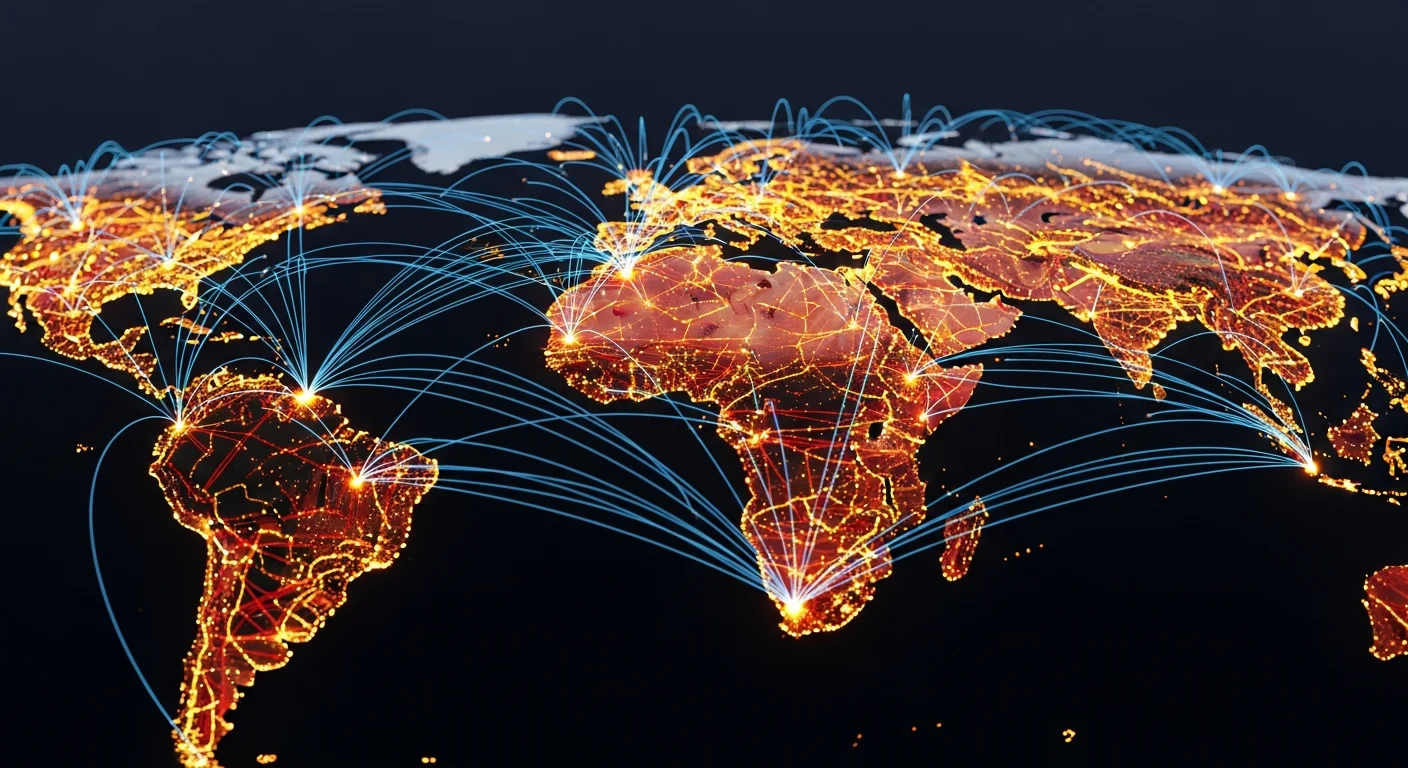
Fermat is the circulatory system of the conglomerate. Every division that produces physical output ships it through the Fermat network.
Highfield Magnetics — Superconducting maglev rails for the evacuated tube network. CRYO-10 Halbach arrays for H-LEV levitation and propulsion. Magnetic isolation chambers for σ-3 payload transport. The largest deployed fleet of CRYO-10 units outside fusion and aerospace.
Vapor Vacuum — Vacuum system engineering for the evacuated tube network. Maintains reduced-pressure corridors across the campus network at scale.
Lorentz Aerospace — Composite hull design for MHD sea vessels. Aerodynamic body development for high-speed ground platforms.
Maxwell Continuum — H-Array wireless power transfer for charging infrastructure across ground convoy corridors and drone staging areas.
Foundation Kinetics — Automated cargo handling systems — robotic loading, unloading, and inter-modal transfer at depot nodes.
Aetheric Sciences — Computational infrastructure for the Nexus solver. Route optimisation at scale across five transport modes requires significant processing capacity.
Metallic Sciences — Origin for the highest-volume recurring route: weekly MS-7 titanium billet convoys to Lorentz Aerospace.
Cellular Foundry — Origin for the highest-priority route: u=1.0 synthetic organ delivery with air swarm override authority.
the Foundation — Emergency dispatch coordination for MK-Oasis humanitarian deployments.
Highfield Magnetics → Vapor Vacuum → Lorentz Aerospace → Maxwell Continuum → Foundation Kinetics → Aetheric Sciences → Metallic Sciences → Cellular Foundry → the Foundation →
RESEARCH REPOSITORY
Variational optimisation, autonomous transport, and supply chain infrastructure.
Moving matter from origin to destination by the optimal path. Named for Fermat's principle of least time: among all possible paths, nature selects the one that extremises the action. Fermat Logistics applies this variational framework to physical freight across five transport modes spanning autonomous ground convoys, drone swarms, MHD sea vessels, superconducting maglev tube networks, and electromagnetic launch systems. Every routing decision minimises a weighted cost functional subject to payload sensitivity and network constraints.
(wiki) Fermat's Principle • (wiki) Calculus of Variations • (wiki) Snell's Law • (wiki) Brachistochrone Problem • (wiki) Vehicle Routing Problem • (wiki) MHD Drive • (wiki) Magnetic Levitation • (wiki) Electromagnetic Launch • (wiki) Vehicle Platooning • (wiki) Evacuated Tube Transport
- Hecht, E. Optics. 5th Ed. Pearson, 2017. ISBN 978-0-133-97722-6.
- Toth, P. & Vigo, D. Vehicle Routing: Problems, Methods, and Applications. 2nd Ed. SIAM, 2014. ISBN 978-1-611-97358-7.
- Franklin, G.F. et al. Feedback Control of Dynamic Systems. 8th Ed. Pearson, 2019. ISBN 978-0-13-468571-7.
- Shapiro, A. et al. Lectures on Stochastic Programming. 2nd Ed. SIAM, 2021. ISBN 978-1-611-97642-7.
- Kowalski, M.R., Chen, L.X., Petrov, A.N., "Optimization of Transport Paths Through Theoretical Medium Properties: Exploring Alternative Logistics Paradigms Beyond Conventional Spacetime," Journal of Advanced Transportation Theory, vol. 47, no. 3, 2023.
- Bernoulli, J. "Problema novum." Acta Eruditorum (1696). The brachistochrone problem — the founding problem of the calculus of variations.
- Dantzig, G.B. & Ramser, J.H. "The truck dispatching problem." Management Science 6(1), 80–91 (1959). doi:10.1287/mnsc.6.1.80
- Ambrose, S.E. Nothing Like It in the World: The Men Who Built the Transcontinental Railroad 1863–1869. Simon & Schuster, 2000. ISBN 978-0-684-84609-5.
- Lipinski, R.J. et al. "Space applications for contactless coilguns." IEEE Trans. Magnetics 29(1), 1993. doi:10.1109/20.195594
- ● Snell's law as logistics analogy: the path bends at modal boundaries exactly as light bends at refractive index boundaries. The mathematical framework (calculus of variations) is identical.
- ● Cost functional minimisation with sigma-class constraints: standard constrained optimisation. The variational formulation is the contribution — treating routing as continuous-space optimisation rather than graph search.
- ● Autonomous vehicle platooning: demonstrated by multiple companies. Aerodynamic coupling at close spacing reduces energy consumption 10–15% for trailing vehicles.
- ● Multi-rotor drone swarm coordination: demonstrated at research scale. Distributed load frames for coordinated heavy lift demonstrated up to 1+ tonne.
- ● MHD seawater propulsion: demonstrated (Yamato 1, 1992). Efficiency below conventional propulsion at current field strengths. Higher-field superconducting magnets are the development path.
- ● Evacuated tube maglev: individual components (maglev, vacuum tubes) demonstrated separately. Integrated system at hundreds of kilometres scale is an engineering development target.
- ● Electromagnetic launch to LEO: NASA studies (Lipinski et al.) establish feasibility for cargo. Multi-kilometre tube, GW-scale power delivery, and thermal management at exit velocity remain engineering challenges.
- ● Union Pacific constraint-driven acceleration: historical record. 10 miles of track in 24 hours documented April 1869. See Ambrose (2000).
- ● Lobito Corridor modal lock-in: real infrastructure control mechanism. Export quotas bound to corridor designation over multi-year commitment periods.